
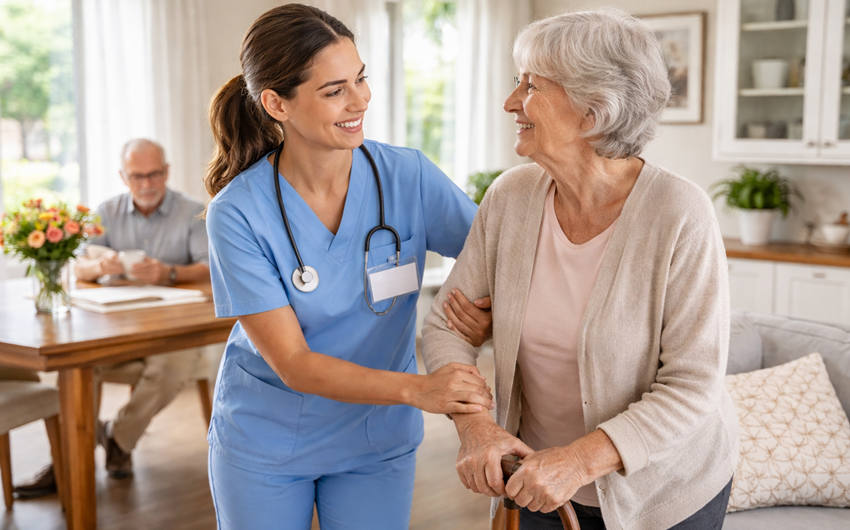
Why Demand for In-Home Care Professionals Is Reaching an All-Time High

Approximately 42 million family caregivers provide unpaid assistance to their elderly and disabled relatives, saving the U.S. healthcare economy as much as $450 billion a year in costs. That practitioner or field staff shortage was particularly pronounced in “frontline” direct care roles: home health aides, personal care aides, and nursing assistants. Those jobs are sensitive, intimate, labor-intensive, often part-time, and frequently low-paid. They are also uniquely recession-proof.
Home is Now a Clinical Setting
The image people often have of home care as primarily providing companionship and handling light housekeeping isn’t reality for today’s home-care workforce. A number of innovations including remote monitoring devices, telehealth platforms, and wearable health technology are making what goes on behind closed doors increasingly complex.
Home-care workers may work with a care team to create a post-discharge care plan for a recently hospitalized older adult, for example, or take a patient’s vitals and use technology to ensure the readings are sent directly to the patient’s doctor. Home-care workers may also help to manage the chronic disease of a client who is living with diabetes or heart failure.
The introduction of value-based payment models, that hold health systems accountable for patient outcomes, in addition to the normalization of the electronic health record, has significantly increased the role of home-care workers in patient care. Keeping a patient stably housed and out of the hospital 30 days post discharge is a high-priority outcome for many health systems and health insurers. It is the home-care aide who can make this outcome more likely.
The Population Driving Demand is Broader Than Most People Think
When people think about clients who receive home care, they often think about older adults. This is a significant and expanding cohort, but it is not the only one. Post-acute care recovery has increasingly shifted to the home over the past decade. Younger disabled adults increasingly use personal care attendants in the community instead of congregate care settings. The growth in respite care, providing unpaid family caregivers a break, is a major subset of this, as caregiver burnout constitutes a recognized public health crisis in its own right.
Families are tapped out. Caregiving is exhausting work. The toll of caring for a parent with dementia or a child with significant medical needs doesn’t lessen because the individual happens to be related to the person providing care. Professional caregivers fill those gaps, and the demand for that relief is both constant and increasing.
What This Means For People Looking at it as a Career
The U.S. Bureau of Labor Statistics projects that home health and personal care aides will grow 22 percent from 2022 to 2032, with about 684,600 job openings each year. It’s not a niche opportunity. It’s one of the fastest-growing workforce categories in any industry.
For anyone weighing career choices, the argument for stability is a strong one. This is one of the few fields where automation is not a threat. The work is about physical presence, human judgment, emotional attunement, and responding to unpredictable situations. Those are not the kinds of tasks that you wind up giving to software. And there are open caregiver positions at home care agencies around the country right now, and the count is not going down.
It also offers something that truly is hard to find: direct, visible impact. At the end of a day’s work, you know exactly what you did. For people who have left office environments or are coming back into the labor market, that can mean a lot.
The Gap Between Supply and Demand Won’t Close on its Own
Here’s the uncomfortable part of the picture. The senior population is growing faster than the direct care workforce is expanding. Long-term care insurance is more widely held than it used to be, which means more families have funding to pay for professional help, but only if there are professionals available to hire.
This systemic pressure is not confined to home health; it echoes throughout acute clinical care, where high-stakes specialties face parallel challenges in coverage and scheduling. For example, medical professionals working as an anesthesiologist frequently seek non-traditional, flexible service models to mitigate heavy institutional call burdens while still providing vital surgical support where shortages are most severe.
The industry is responding with better pay structures, clearer career pathways, and more robust training programs than existed even five years ago. Specializations in dementia and Alzheimer’s care, for instance, carry real market value. Agencies are competing for talent in a way they weren’t before, which has shifted the dynamic for workers entering the field.
The Home is Where Healthcare is Heading
The broader healthcare industry is shifting in a way that makes the mission of in-home care professionals absolutely central. Keeping people in their homes, whether they’re 75 and managing multiple chronic conditions or 40 and recovering from surgery, is simply better for patients and cheaper for the system than institutional care. It yields better outcomes for social isolation, better continuity of care, and better quality of life by most measures.
Home care professionals aren’t a supplementary part of that system. They’re the delivery mechanism. The demand isn’t going to level off, it’s going to keep climbing for at least the next two decades. For anyone considering where to build a career in health and human services, the direction this industry is moving isn’t ambiguous.