
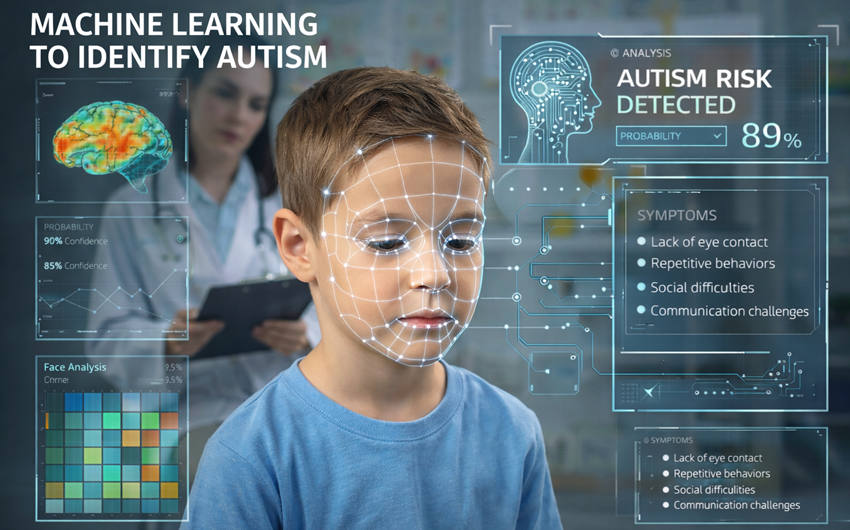
How Machine Learning May Support the Identification of Autism

Emerging technologies, such as artificial intelligence (AI), may support autism screening and the identification of autistic traits.
Researchers are studying how AI eye-tracking can be used for early autism screening. Although it can be difficult to analyze large behavioral datasets to detect patterns through observation alone, machine learning can help researchers identify those patterns.
However, clinician judgment remains an essential element of autism identification.
Research on Eye-Tracking and Autism
Several studies have explored the relationship between autism and gaze behavior.
For example, research published in Scientific Reports used eye-tracking to examine how children responded to predictable and unpredictable motion. Children who showed indications of autism spent more time observing predictable patterns. The results revealed visual attention differences that researchers can measure during their screening studies.
Other research published by Frontiers in Psychiatry examined how eye-tracking metrics help researchers study attention patterns associated with autism. Additional Frontiers in Neuroscience studies delve into how machine learning models analyze eye-movement data to identify patterns that may be associated with autism-related behaviors.
Each of these studies illustrates how gaze patterns may provide behavioral signals that researchers can examine using computational methods.
Keeping Machine Learning in Perspective
Machine learning works by identifying patterns across large sets of data. In terms of autism research, datasets might include gaze behavior, visual attention, or responses to social stimuli.
These types of tools help researchers study how autistic and non-autistic participants attend to people, movement, and objects.
It’s paramount, however, that AI-based findings are viewed as just one source of information. They can’t replace a clinician-led process—one that considers developmental history, observation, caregiver input, and standardized assessments.
The best path toward identifying autism and autistic traits is a whole-child approach.
AI-Based Insights and Clinician-Led Assessment
Clinicians typically rely on established tools to understand communication, social interaction, sensory experiences, and behavior across settings. For example:
• ADOS-2 (Autism Diagnostic Observation Schedule, Second Edition): This structured observational assessment helps clinicians examine social communication and related behaviors in a standardized way.
• MIGDAS-2 (Monteiro Interview Guidelines for Diagnosing the Autism Spectrum, Second Edition): A sensory-based interview and observation process, this assessment can help evaluators gather qualitative information about strengths, interests, and developmental experiences.
• SRS-2 (Social Responsiveness Scale, Second Edition): This assessment gives clinicians and educators a rating scale that measures social responsiveness and helps identify patterns associated with autistic traits across everyday settings.
As part of a broader evaluation, professionals may include speech-language and sensory assessments. While speech-language measures can clarify expressive, receptive, and pragmatic communication patterns, sensory assessment helps clinicians understand how sensory processing can shape daily participation, regulation, and social interactions.
A Whole-Child View of Autism Identification
No single score, observation, or algorithm can truly capture the full picture of any individual’s development. That’s why a thoughtful evaluation must draw from multiple sources as it considers each individual in context.
While machine learning may eventually strengthen both screening and research, the most meaningful understanding will still come from a thorough, clinician-led process.
Professionals can explore additional resources if they’re seeking tools that support a comprehensive autism assessment.