Cartagena, Coffee, and the Metrocable: A First-Timer’s Loop Through Colombia

You land in Cartagena at 3:00 in the afternoon and the heat hits you before the customs line does. By the time you reach Plaza Santo Domingo and order your first limonada de coco, the country has already shifted something in you — not in a dramatic way, just in the quiet way that warm places do when you’re not expecting it.
That is the loop in a sentence. Cartagena loosens you up. The Eje Cafetero slows you down. Medellin sends you home with stories you’ll trim for whichever audience you’re talking to.
This is the guide I wish someone had handed me before my first trip.
TL;DR
- A first-timer’s Colombia loop is 10 to 12 days: Cartagena (3 nights), the Eje Cafetero coffee zone around Salento or Filandia (3-4 nights), and Medellin (3-4 nights).
- You fly the long legs. Drive-times look short on a map and are not. Cartagena to Pereira is a one-hour flight or a 16-hour bus.
- Phone coverage is strong in the cities and patchy on the rural coffee-farm roads between Salento, Filandia, and the Cocora Valley. Download offline maps before you head in.
- Cartagena is Caribbean-hot. Eje Cafetero sits at 1,400-1,800m and gets chilly at night. Medellin runs in the high 70s°F all year. Pack three weights of layers.
- You will eat bandeja paisa once. You will not need to eat it twice.
A loop, not a line: pacing Colombia for first-timers
Colombia is not a country you cross. It is a country you orbit. The two coasts and three mountain ranges that run the spine of the country mean that almost no route is a straight line, and the loop most first-timers settle on,Cartagena, Eje Cafetero, Medellin,is the one that gives you a coast, a countryside, and a city without putting you on a bus for 30 hours total.
Ten days is the minimum and feels rushed. Twelve is the sweet spot. Fourteen lets you add Bogota or Guatape without dropping anything else. Anything less than ten and you’ll spend the trip in airports.
The order matters. Open in Cartagena because the heat is the part you most want to remember. End in Medellin because the city earns the last word.
Days 1-3: Cartagena and the walled city
You sleep inside the walls if you can afford it and just outside in Getsemaní if you cannot — both are walking distance, and Getsemaní has the better street food anyway. The first morning is for the walls themselves. Walk them at 7:00 a.m. before the sun turns brutal. Have breakfast at Café del Mural and order whatever the waiter recommends in Spanish even if you don’t understand the answer.
Day two is the islands. The Rosario archipelago is the standard half-day boat trip and it earns the cliché. Book through your hotel rather than the dockside touts. The water is clearer at Isla Grande than at Playa Blanca and the crowds are thinner by about half.
Day three you slow down. Get lost in San Diego. Eat lunch at La Cevichería, which Anthony Bourdain put on the map and which somehow has not lost the plot since. Walk the city wall at sunset. There is no rule that says you have to do five things in Cartagena. Two is enough.
Day 4: the move to the coffee zone
Fly. Seriously, fly. The Cartagena-to-Pereira route runs daily on Avianca and Latam, costs around $80-120 USD one-way if you book a week ahead, and lands you in the heart of Eje Cafetero in about an hour. From Pereira airport, a taxi to Filandia is 45 minutes; to Salento, about an hour. Hire the taxi at the official desk inside the terminal,not from the men standing outside.
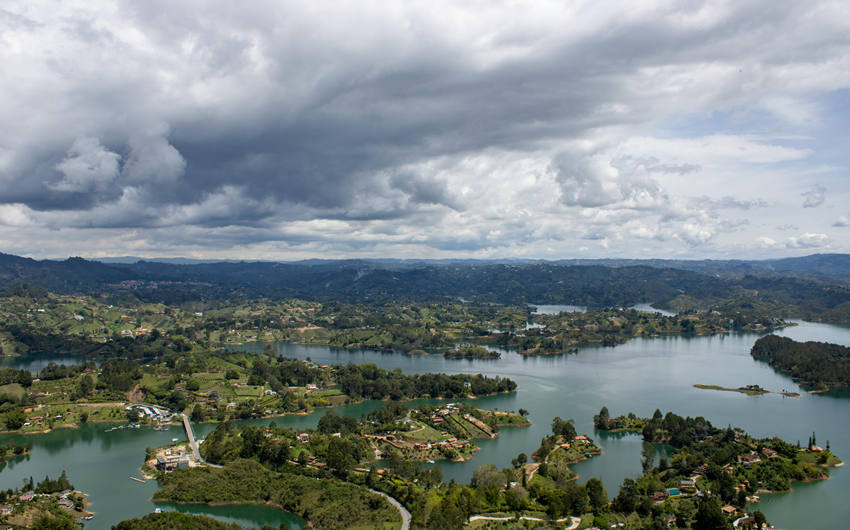
A breathtaking aerial view of Guatapé’s vibrant landscape and intertwined waterways in Colombia.
If you have time, Filandia is the better base. Quieter than Salento, the same proximity to the Cocora Valley, and a town square that hasn’t yet been remade for Instagram. Salento is louder, more colorful, and more set up for English-speakers. Pick the one that matches your noise tolerance.
Days 5-7: the Eje Cafetero, slowly
This is the part of the trip you don’t push.
You wake up to mist. You drink coffee that was picked four miles from where you’re sitting. You walk to a finca;a working coffee farm,and learn the difference between a washed and a natural process from someone who has been doing it for thirty years. Hacienda Venecia, Finca El Ocaso, and Finca Don Eduardo all run good morning tours in English for around $25-40 USD. Book direct, not through a reseller.
The chiva buses are the way you get between towns. Painted in red, yellow, and blue, with open sides and wooden bench seats, they leave Salento’s main square for Cocora Valley every morning at 6:30, 7:30, 9:30, and 11:30. The fare is 4,000 Colombian pesos one-way, paid in cash to the driver. There is no website. You show up.
The Cocora Valley itself is a five-to-six-hour loop hike through the wax-palm cloud forest. Wear waterproof shoes; the middle section turns to mud after almost any rain. Do not skip the hummingbird sanctuary at Acaime — it costs 5,000 pesos to enter and includes a hot drink, and the birds will land on your hand if you stay still enough.
Day 7 is for nothing. Stay in town. Read a book at the Jardín Botánico in Quindío. Eat trout at one of the riverside restaurants in the valley. The Eje Cafetero does not reward hustle.
Days 8-10: Medellin and the Metrocable
You fly Pereira to Medellin in about 30 minutes, or you take the four-hour bus through the mountains if you want the scenery and have the patience. The bus is the better story; the flight is the better decision.
Stay in El Poblado or Laureles. El Poblado is the nightlife and the expat crowd; Laureles is quieter, more local, and closer to the stadium if you want to catch a Nacional or Medellín match. Either works.
The Metrocable is the day-one move. Take the metro to Acevedo station, then the Line K cable car up to Santo Domingo. The ride costs 3,200 pesos and gives you the view of the Aburrá Valley that defines the city’s geography in a way nothing else does. From Santo Domingo, you can switch to Line L and continue up to Parque Arví, a high-altitude park that feels like another country.
Day two is Comuna 13. Take a guided walking tour with one of the local-led operators,Casa Kolacho and Zippy Tour are the two most-recommended,and learn what the neighborhood was, what it became, and what its residents think about both the violence and the tourists. The outdoor escalators are the postcard. The graffiti tour is the substance.
Day three is for Guatape or for sleeping in. The painted-village day trip to Guatape and El Peñol is the most-photographed thing in Antioquia and it earns the photos. Or you stay in Medellin, eat at Carmen, and walk the river. Both are correct answers.
Staying online across the route
Cartagena and Medellin are easy. The Eje Cafetero is where most first-timers run into the gap they didn’t plan for, and the chiva-bus connectors between coffee-farm towns are the stretch where your maps app will start lying to you. A small amount of preparation fixes most of it.
What works where
In Cartagena and Medellin, all four Colombian carriers;Claro, Movistar, Tigo, and WOM — run solid 4G across the urban grid and Claro adds 5G in the central districts of both cities. You will not notice the difference unless you are streaming. The walls of Cartagena’s old town have dense signal; Comuna 13’s hillside has thinner coverage at the top of the escalators but works fine for navigation.
In the Eje Cafetero, the picture changes. Claro has the widest rural footprint across Quindío, Risaralda, and Caldas, and is the carrier most coffee fincas route to by default. On my second trip, I ran a local data line through the HelloRoam connection across Colombia, which connected to Claro across the coffee zone, and had usable 4G through the chiva-bus ride from Salento to Cocora and back. Movistar is the second-strongest carrier on the high mountain roads above 1,800m. Above the wax-palm sanctuary at Acaime, signal goes to nothing,bring offline maps.
Offline maps and what to download
Before you leave Cartagena, do three things on the hotel wifi. Download offline regions in Google Maps for Pereira, Salento, Filandia, Cocora Valley, and Medellin separately. Save the Maps.me offline pack for Quindío. And download a Spanish offline pack in Google Translate. The chiva-bus drivers do not speak English and the timetable in Salento’s main square is hand-painted on a board.
That is the entire connectivity plan. Phones are useful here. They are not the trip.
What it costs
A first-timer’s 10-12 day loop, mid-range, runs roughly $1,400-2,200 USD per person before flights into Colombia. Domestic flights between cities add $200-300. Hotels run $50-120 a night in Cartagena, $40-90 in the Eje Cafetero, and $50-100 in Medellin. Coffee farm tours, the Cocora hike, and the Guatape day trip each fall in the $25-60 range. Meals at sit-down restaurants are $8-18 per person; a pintada at a corner stand is under $4.
You will spend less than you expect. You will tip more than you expect, and you should.
Comparison: which base in the coffee zone
| Base town | Vibe | Best for | Walk to Cocora? | Coffee farm density |
| Salento | Lively, colorful, English-friendly | First-timers, solo travelers | Chiva-bus, 30 min | High |
| Filandia | Quiet, local, slower pace | Couples, return visitors | Day trip via Salento | Medium |
| Pereira | City base, more hotel options | Business travelers, short stays | Day trip, 1.5 hr | Low |
| Manizales | Higher altitude, university town | Nature, paragliding | Long day trip | Medium |
FAQ
How many days do you need for Cartagena, Eje Cafetero, and Medellin? Ten days is the minimum that doesn’t feel rushed. Twelve is the sweet spot. Plan three nights in Cartagena, three to four in the coffee zone, and three to four in Medellin. Anything less than ten and you’ll spend half the trip in transit.
Is the Eje Cafetero loop safe for first-timers? Yes. The coffee zone is one of the safest regions in Colombia for tourists and has been for over a decade. Stick to the standard practices,taxi from official ranks, don’t flash electronics on rural buses, watch your drink in nightlife districts,and you’ll be fine. Solo travelers, including women, regularly do this loop without incident.
How do you get from Cartagena to the coffee zone? You fly. Avianca and Latam both run daily Cartagena-to-Pereira flights for around $80-120 USD one-way. The flight is about an hour. The bus alternative is 16 hours and not worth it unless you have a strong reason.
Does phone service work in the coffee farms? In the towns (Salento, Filandia, Pereira), yes. On the rural roads between coffee fincas and on the Cocora Valley hike above 1,800m, signal drops to patchy or nothing. Claro has the widest rural footprint in the coffee zone. Download offline maps in Google Maps and Maps.me before you leave town wifi.
When is the best time to visit Colombia for this loop? December through March is the dry season and the easiest weather for the loop. July and August are a shorter dry window and busier with European visitors. April-May and October-November are the rainy seasons, which makes the Cocora hike muddier but does not stop the trip. Cartagena is hot year-round; pack for sea-level heat regardless.
Closing note
The loop is not a checklist. You will skip something on this list and add something I didn’t mention, and that is the trip working as it should. Colombia rewards the traveler who lets the country set the pace.
You come for Cartagena. You stay for the coffee zone. And somewhere on the Metrocable looking down at the Aburrá Valley, you start planning your second trip back.