What Does Ideal Food Packaging Look Like

Soup arrives warm or cold. Salad stays crisp or turns into mush. The container holds its shape or leaks in the bag. The difference between these scenarios almost always comes down to packaging, and it is packaging that determines whether a guest receives the dish the way the chef intended it — or something else entirely.
Good packaging is built from several components, and none of them work in isolation.
Temperature: The Main Enemy of Delivery
Food loses quality fastest through temperature. A hot dish packed in a thin container without insulation cools down within 15 to 20 minutes. A cold dessert in poorly designed packaging starts to melt before the courier reaches the address.
Good packaging addresses this through material and construction. Bagasse and foamed biomaterials retain heat significantly longer than thin plastic. Double walls create an air gap that slows heat transfer. A tightly sealing lid traps steam inside and prevents the dish from drying out.
Temperature control is the first criterion professional buyers use to evaluate packaging. Everything else follows from there.
Leak-Proofness: Between the Container and Disaster
A leaking container means sauce on clothing, a soaked bag, and a dish that lost half its flavor along with the liquid. The leak-proofness of packaging directly determines what condition the dish arrives in.
Signs of a quality container in terms of leak-proofness:
• the lid seals tightly, without play, and does not open when tilted;
• the base holds the weight of the contents without deforming;
• seams and edges are formed or bonded without gaps.
These parameters can only be verified in practice, which is why professional suppliers like McDonald Paper & Restaurant Supplies provide samples before purchase. For a restaurant, a leaking container equals a lost guest, and that risk is factored into the choice of container from the start.
Material: What It Is Made Of Matters
Packaging comes into direct contact with food. That means the material affects not only environmental impact but the safety of the dish itself.
Low-quality plastic releases chemical compounds when heated that migrate into food. This is especially relevant for hot dishes and fatty products, which accelerate the migration process. Food-grade plastic reduces this risk, but alternative materials eliminate it entirely.
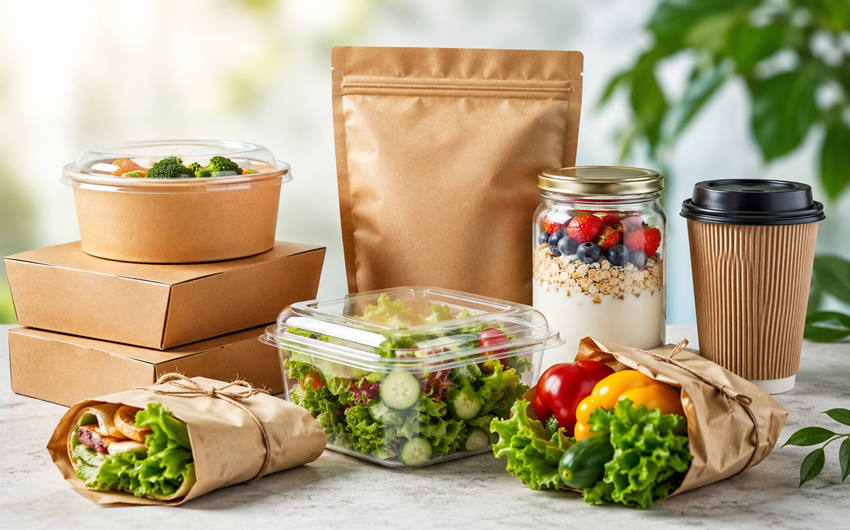
Bagasse, bamboo, kraft paperboard, and PLA bioplastic are the materials used in quality food packaging today. Each has its own strengths:
• bagasse retains heat and moisture well, making it suited for hot dishes;
• kraft paperboard breathes, which matters for baked goods and sandwiches;
• PLA is transparent and works well for cold dishes and desserts that need to be visible.
The choice of material is determined by the specific menu and service format, not by general preference. Hot soup and cold cheesecake require fundamentally different solutions, and trying to cover both scenarios with a single container type almost always ends in a compromise on quality.
Ease of Use: Packaging Designed for People
Packaging does not exist in a vacuum. It is opened by a real person, often hungry, often on the go. A lid that cannot be removed with one hand, a container with no comfortable grip, a sauce packet that sprays when opened — all of these details combine into an overall impression of the order.
Good packaging opens easily and predictably. Portions are arranged so the dish looks appealing after opening. The container stands stable on any surface. These requirements seem obvious, but they are precisely the ones most often ignored when packaging is chosen on the basis of lowest price.
Ecology: Market and Regulatory Pressure
Consumers notice what their food arrives in and form opinions about the establishment based on it. Packaging made from non-recyclable plastic reads today as a signal that the business is indifferent to what happens after the guest closes the door.
Regulators are moving in the same direction. Major cities and European markets are steadily introducing restrictions on single-use plastic, and businesses that adapted early do not spend time and money on forced ассортимент replacements under tight deadlines.
Eco-friendly materials available to the restaurant industry today:
• bagasse and bamboo pulp compost within 60 to 90 days;
• kraft paperboard is processed through standard municipal recycling systems;
• PLA bioplastic breaks down in industrial composting facilities.
All three options are already available at prices comparable to conventional plastic, and the difference in procurement cost in practice turns out to be considerably smaller than commonly assumed. Switching to eco-friendly materials is more a matter of decision than budget.
Appearance: The Container as a Point of Contact
For restaurants operating on delivery, packaging is effectively the only physical point of contact with the guest. It stands in for the interior, the service, and the atmosphere. A container that looks neat, clean, and professional sets an expectation of quality before the guest even opens it. A dented lid, a stain on the side, a crooked label — all of this works in the opposite direction and creates an impression of carelessness that transfers onto the dish itself.
This is particularly relevant for new customers ordering for the first time. There is no prior experience with the restaurant to fall back on, no memory of a good meal to offset a bad first impression. The packaging is the entire introduction. A well-presented container signals that attention to detail extends beyond the kitchen, and that signal lands before a single bite is taken.
What Makes Packaging Truly Ideal
Ideal food packaging holds temperature, seals properly, is made from safe materials, opens without effort, looks the part, and after use breaks down rather than accumulating in landfills for decades. For the consumer, this means a dish that arrived exactly as the chef intended. For the business, it means a guest who orders again.
None of these qualities exist independently. A container that holds temperature but leaks is a problem. A container that looks great but releases chemicals into hot food is a bigger one. Packaging works as a system, and every element in that system has a job to do. The businesses that understand this stop treating packaging as a commodity and start treating it as part of the product itself.