
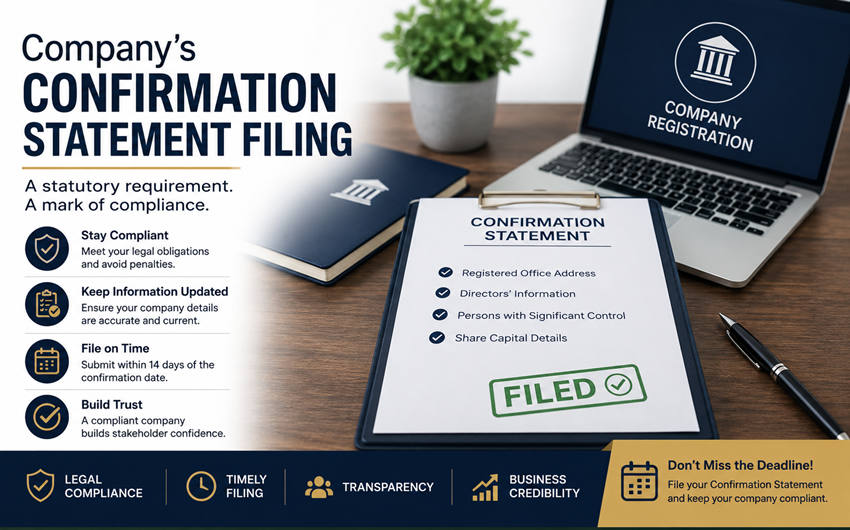
What Details Are Included In A Confirmation Statement Filing?

Running a company comes with various legal obligations, and updating your business information is among the most critical ones. A confirmation statement is a mandatory filing that ensures that the details of your company are properly registered with the appropriate authorities. You do not have to submit new information each time, but it requires you to confirm that all the information that is already on record is correct.
This filing covers major areas of your company, including ownership and business operations. It helps maintain transparency and ensures that your company remains compliant with legal requirements. Thus, it is important to understand what details are included in a confirmation statement because even small errors can lead to complications.
In the following sections, you will clearly understand each component you need to review and confirm.
1. Company Details Including Registered Office Address
A confirmation statement filing begins with your company’s basic information. This includes your registered office address, company name, and company number. Such information officially identifies your business, hence precision is quite significant.
The address of your registered office is particularly significant as it is the place where official documents and legal notices are posted. When this address is wrong, you can miss out on valuable communication. Therefore, it should always reflect your current and valid address.
Moreover, it also records the jurisdiction in which your company is registered. This appears to be a simple step, but it is the basis of all your filing. By reviewing these details carefully, you make sure that the identity of your company is correct and compliant.
2. Shareholder Records Covering Names, Addresses, and Share Ownership
Your shareholder information is another important section of the confirmation statement. The register of members contains the names and addresses of all shareholders. This ensures that ownership details are clearly recorded.
It also shows the number of shares held by each shareholder. This knowledge demonstrates the way your company is structured and who possesses authority. Even minor variations in the shareholding have to be reflected correctly to prevent differences.
Moreover, updating these records assists in ensuring transparency in your business activities. When the information about your shareholder is wrong, it will cause misunderstanding or legal issues. Thus, this ensures that ownership details are clearly and accurately presented.
3. Statement Of Capital with Share Classes and Values
The statement of capital provides a detailed overview of your company’s share structure. In this section, you need to outline the total number of shares issued by your company. This comprises all shares presently owned by shareholders.
Besides, it also outlines different classes of shares if your company has more than one type. As an illustration, certain companies have ordinary shares and preference shares, each having varying rights. It is important to ensure these classifications are accurate.
Furthermore, it shows the nominal value of each share. This is the face value of the shares at the time they are issued. When you take these details into account, you make sure that the financial structure of your company is properly registered and understood.
4. Persons With Significant Control and Ownership Rights
When you are preparing your confirmation statement, you should always read the information about any person with significant control, also referred to as PSCs. These are people who would be of great influence to your company, usually through ownership of shares or control over voting decisions.
You must disclose correct details regarding every PSC, such as their full name and the kind of control they possess. For example, this may involve holding a large percentage of shares or having the authority to make key business decisions. It is important to ensure that these details are complete and up to date.
This section plays a key role in maintaining transparency within your company. By including this information properly, you assist in making sure that the right people who have control of the business are properly identified and registered.
5. SIC Codes Defining Company Business Activities and Operations
SIC codes are used to describe what your company actually does. When filing your confirmation statement, you need to check that your business activities are correctly classified using these codes.
Each code represents a specific type of business activity. If your company operates in more than one area, you can include multiple codes. However, it is important to ensure that they accurately reflect your operations.
Over time, your business may evolve, and your activities may change. Therefore, reviewing your SIC codes during each filing is essential. This helps ensure that your company’s profile remains accurate and aligned with its current operations.
6. Trading Status of Shares on Regulated Markets
In some cases, this section includes details about whether your company’s shares are traded on a regulated market. This applies mainly to certain types of companies, but it is still an important detail to review.
It shows whether your shares are listed or admitted to trading on any official market. This information helps provide a clear picture of your company’s financial standing and public presence.
Even if your company is not listed, you still need to confirm this status. By doing so, you ensure that your filing is complete and that all required information has been accurately declared.
7. Confirmation Of Accurate Company Records and Compliance
Finally, the confirmation statement includes a declaration that all company records are accurate and up to date. This is a formal declaration that everything you have reviewed is correct.
This step is important because it places responsibility on you to ensure compliance. If any information is incorrect, it could lead to penalties or further scrutiny. Therefore, you should only confirm once you are confident in the accuracy of all details.
By completing this declaration, you demonstrate that your company is meeting its legal obligations. It also shows that you are maintaining proper records, which is essential for smooth business operations.
Conclusion
A confirmation statement may seem like a routine task, but it plays a vital role in maintaining your company’s legal standing. By carefully reviewing each section, you ensure that your business information remains accurate and transparent. From company details to shareholder records and control structures, every part of the filing contributes to a complete picture of your organisation.
Taking the time to understand these details helps you avoid mistakes and ensures compliance with legal requirements. When you approach this process with care and attention, you protect your company from unnecessary risks and keep your business running smoothly.